
Book publishing is a key part of personal brand building that is often overlooked. When customers read your book, it is like having a warm conversation with you. It allows them to get to know you and it allows you to tell your story, demonstrate your expertise and build credibility while providing more value to the world.
In this article, we will look at the different self publishing websites that can help you reach a broader audience, as well as options for you to consider when deciding on the route you would like to go to become an author. Whether publishing on KDP or the other platforms, you need to have a solid understanding of what they entail. Below are the main topics this article will cover.
Before Publishing Online
Before self-publishing online, you need to first make sure you have an audience. Don’t dive into releasing a book if no one knows you yet, because building an audience of supporters takes time. You need an audience you can grow from. Do you have an email list? An established email list can give you the momentum you need to launch your book successfully—the larger and more engaged, the better. You may also have an active social media following or community of supporters you can leverage.
Also, do you have a budget to design and market your book? Your potential readers are out there, and you need a design that will grab their attention and make them want to learn more. Do you have time to promote your book, or friends and family who can help spread the word? If not, having a sufficient marketing budget becomes even more important.
Finally, as part of your publishing strategy, you need to consider the different self-publishing platforms available and understand the unique advantages each one offers.
Self Publishing Websites
1.) Kindle Direct Publishing
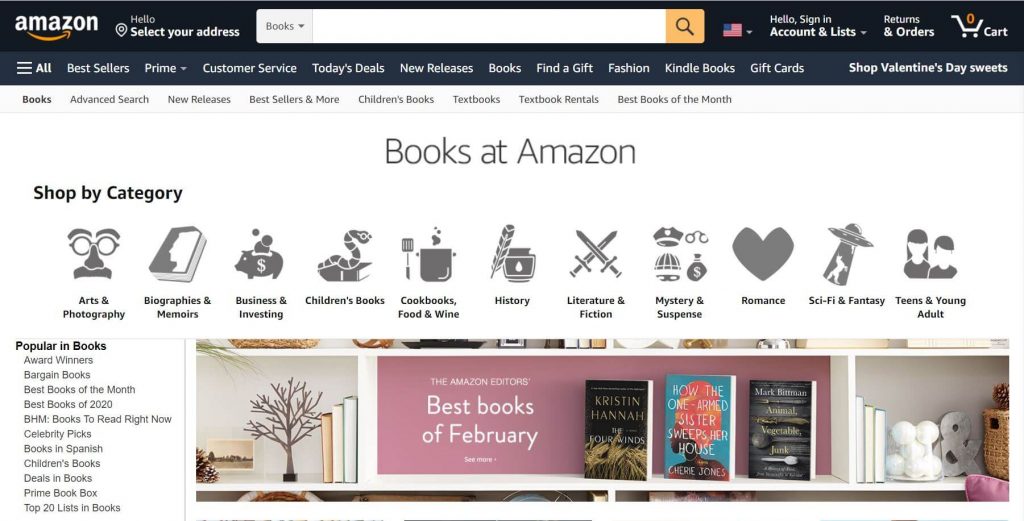
Of all the self-publishing platforms available, Amazon KDP is one of the largest and most important for authors to consider. Amazon dominates the U.S. ebook market through Kindle, giving self-published authors access to a massive audience of potential readers.
Amazon transitioned its former print-on-demand service, CreateSpace, into Kindle Direct Publishing (KDP) in 2018. Today, KDP allows authors to publish ebooks, paperbacks, and hardcover books, which are printed on demand and sold through Amazon marketplaces around the world.
By publishing with KDP, you can reach millions of potential readers while gaining access to tools and resources designed to help you publish, promote, and earn from your book.
Royalties from KDP
Amazon KDP generally pays royalties approximately 60 days after the end of the month in which the sale was reported. Payment thresholds depend on the payment method and currency. For U.S. payments by check or wire transfer, a $100 minimum threshold may apply, while direct deposit (EFT) has no minimum payment threshold.
Royalty rates vary between ebooks and print books. Your earnings can also be affected by factors such as list price, marketplace, printing costs, page count, trim size, ink and paper type, taxes, and other applicable deductions.
Ebook Royalties
KDP offers two ebook royalty options: 35% and 70%.
35% Royalty Option
The 35% option does not deduct ebook delivery costs when calculating royalties and is available across a broader range of prices and territories. It generally applies when an ebook does not qualify for the 70% option.
35% × (List Price − applicable VAT/taxes) = Royalty
70% Royalty Option
For U.S. sales, eligible ebooks priced between $2.99 and $12.99 may qualify for the 70% royalty option. Eligibility and pricing requirements vary by marketplace. Under this option, delivery costs are generally deducted from the royalty calculation.
When a physical edition of the book is available, the ebook’s list price must also generally be at least 20% below the Amazon list price of the physical edition.
70% × (List Price − applicable VAT/taxes − Delivery Costs) = Royalty
Paperback Royalties
Paperback royalties depend on the book’s list price and marketplace, with printing costs deducted from the royalty. Printing costs vary based on factors such as page count, trim size, ink type, and marketplace.
For U.S. paperback sales on Amazon, KDP currently pays a 60% royalty for books priced $9.99 or higher and 50% for books priced $9.98 or lower, minus printing costs. Books sold through KDP’s Expanded Distribution earn 40% of the list price minus printing costs.
For a qualifying paperback earning 60%, the basic calculation is:
(60% × List Price) − Printing Cost = Royalty
Benefits of Publishing with KDP
1.) Publishing with KDP Offers free ISBN: But note that the free ISBN is only for KDP and can’t be used in other outlets. If you plan to become an author that sells more than one book in multiple platforms and channels then you would need to purchase your own ISBN from Bowker. This ISBN Can be used on any publishing platforms you choose. Including your own website!
2.) KDP offers expanded distribution: Through this program, your book becomes available to major book stores, online retailers, libraries and academic institutions. However, This does not guarantee it will be ordered by a particular bookseller or library. but by offering wholesale discounts you can increase your chances. Also, if you enroll in expanded distribution then you cannot sell your book on any other platform outside Amazon. So if you decide to publish on Ingram Spark then you would have to first opt-out of expanded distribution.
3.) Author central: Author central allows you to promote your book among millions of readers. You can create an author page with info, imagery and your book along with a link to your site, social media and purchase. This would help you boost your personal brand as an author.
4.) KDP Select: KDP Select is a marketing program to help you promote through discounts and countdown deals when publishing with KDP. In this program you grant Amazon exclusive distribution of your book for 90 day period and re-enroll at your own convenience. When you enroll in KDP Select you can run free promotions for up to 5 days out of each 90 day KDP Select enrollment period. No royalties are acquired once promotion runs but once free book promotion ends it will enter the paid list.
The goal of KDP select is to create desire or demand for your book because it is discounted for a limited time. This would improve your organic reach and sales after the deal is over because of the built momentum. KDP select is mostly recommended for fiction authors. This is because the shoppers on Kindle Unlimited, where your book will be listed, are usually fiction readers. But note that once your book is enrolled in KDP Select, you can’t list it in other markets, platforms or channels.
5.) Amazon Advertising: Lockscreen ads allow you to target Kindle e-readers, Fire Tablet Lockscreens and Kindle E-Reader homescreens to reach customers at the right time. Only pay when people click on your ad and target based on genre interests. Use sponsored product ads to promote your titles to readers as they search based on keywords of products in search results and product detail pages.
2.) Ingram Spark
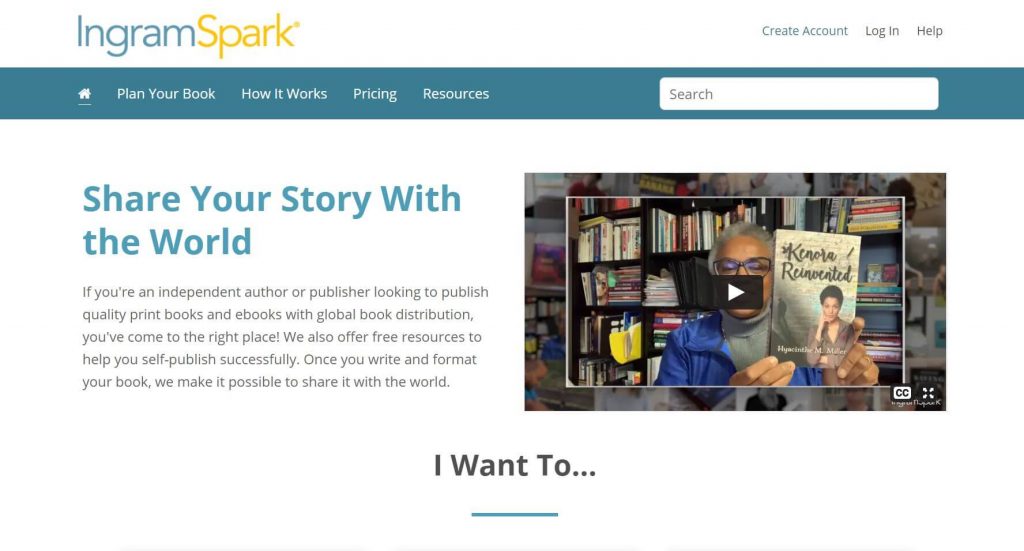
Established by Ingram, the worlds leading distributor for print books. Ingram Spark offers global distribution and reaches other top online retailers like Barnes & Noble and Kobo. Below are some considerations to keep in mind when deciding if you would like to become an author through Ingram Spark.
Ingram Spark recently removed their fees in 2024 so It is now free to publish on the platform.
Ingram Spark charges $85 for an official Bowker ISBN or you can purchase one directly through Bowker.
Royalties from Ingram
Receive your royalties 90 days after the sale. Ingram Spark pays 40% royalties for ebooks. Your royalties for print are determined through many factors like book size, page count, paper type, cover type, list price and how much your wholesale discount is. Follow this link to calculate how much royalties you can expect for a paperback or hardcopy book
Benefits of Ingram Spark
1.) Publish Hardcover books along with paperback and ebook. Ingram Spark also offers more cover sizes to choose from when publishing online.
2.) Free publishing tools and resources allow you to benefit and grow as an author(e.g weekly blog, podcast, courses and downloadable guides.)
3.) Use wholesale discounts to expand your reach in major book distribution channels by helping it get picked up by major retailers and wholesalers (brick-n-mortar, Barnes n Noble, Costco, etc.) By selling at a bulk discount, you can reach major retailers and compete with traditional published books. Sell in bulk on Ingram Spark for as low as 30-35% to attract more wholesale buyers.
4.) You get a broad distribution. Through Ingram Spark you can still reach Amazon, Kobo, Apple, Barnes & Noble and more.
3.) Barnes & Noble Press
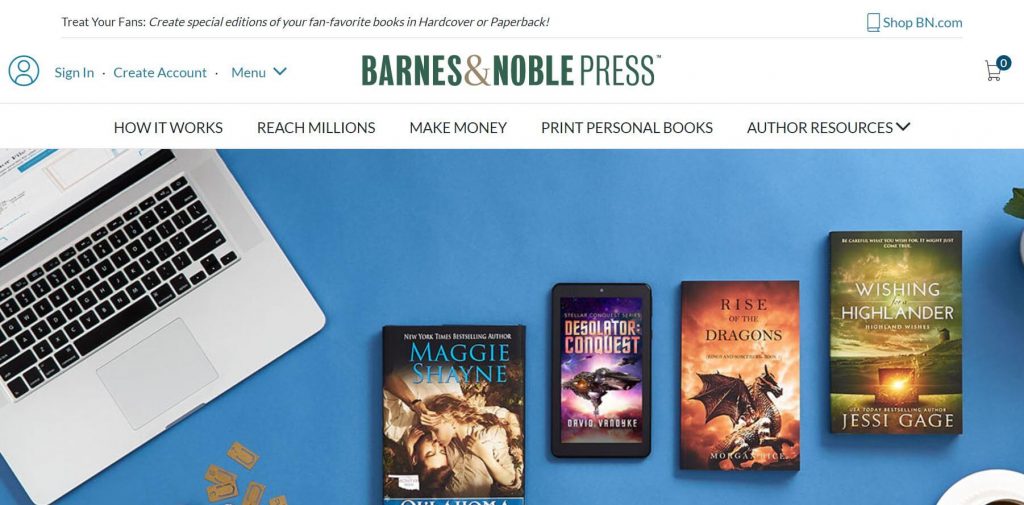
Barne’s & Noble, formerly known as NOOK Press is an online book store for Printbooks, ebooks and magazines. You can take advantage of their self-publishing portal to become an author and establish a stronger presence on their platform. Barnes & Noble is the second largest bookstore in the country. Their national store is purely focused on the US but your customers can easily order from any store across the country. Barnes & Noble is used for only distribution at their online or physical locations.
Royalties from Barnes & Noble
For Barnes & Noble Press, authors receive a 70% royalty on ebooks. For print books, authors receive 55% of the list price minus printing costs. Follow this link to their web page for author royalties.
You can also Follow this link to read more about Barnes & Nobles Royalties
Benefits of Barnes & Noble
1.) Set up preorders before the date of your actual book launch through Barnes & Noble. This can help to build anticipation.
2.) Convenient for hardcopy, as well as both print and ebook publishing.
3.) A variety of resources to help you sell more books, especially if you are new to publishing.
4.) Free, Fast and Easy to Use so you can save your money, time and effort.
5.) A Free ISBN will be provided for publishing only on Barnes & Noble
4.) Ebook Publishing Platforms

i.) Kobo Writing Life: Kobo is a global publishing platform for ebooks and audiobooks, with books available to readers in more than 190 countries. Kobo also offers access to Kobo Plus and allows authors to make ebooks available to libraries through OverDrive.
Ebook royalties can be 20%, 45% or 70%, depending on the book’s price, market and whether it is a public-domain work. In the United States:
- Ebooks priced at $2.99 or higher generally qualify for 70% royalties.
- Ebooks priced below $2.99 generally receive 45% royalties.
- Public-domain works receive 20% royalties.
ii.) Apple Books: Apple Books is one of the world’s major ebook marketplaces and offers authors a fixed 70% royalty on ebooks regardless of price. There are no file-delivery fees, exclusivity requirements or third-party ads. Apple generally pays authors within 45 days after the end of each month.
A Mac is not required to publish. Authors can submit ebooks through Apple’s web-based publishing portal using an iTunes Connect account. For direct web publishing, the finished ebook must be provided as an EPUB file.
Benefits of Ebook Publishing
The reflowable functionality of ebooks allow your readers to change the layout, font size and other attributes based on their own reading preferences.
Eliminate production and shipping/fulfillment costs which can make the shopping experience less convenient for you and your readers. With ebooks they receive their purchase immediately at no extra cost.
Ebooks allow for easier navigation if readers can easily click on the chapter they want from the table of contents. This allows for a more intuitive reading experience.
Ebooks are more sustainable for the environment when you consider the problem of excessive paper printing. This leads to deforestation and environmental concerns.
Ebooks are more portable so your customers can conveniently carry and access several books at once from one device.
Reflowable Ebooks are easier, cheaper and faster to make. So if you are working with a tight budget and a tight deadline to have your book launched then I would highly recommend starting with a reflowable ebook. Ebooks make publishing online simpler.
In conclusion, Publishing online does not have to be complicated. You just need the right support to guide you through the process. We hope you are now able to make more informed decisions on the right self publishing websites to consider. Also, note that the information covered in this article apply as of Sept 2026. These self publishing websites may change how they operate over time. Publishing with KDP, Ingram or Barnes & Noble may be different in the near future. But if you enjoyed this article then you may also like our previous one on 10 ways to sell more books.




2 Responses
I need to have my book featured on your site to increase sells and reach more children living in urban areas.
Hi thanks for reaching out. So the audience that visits this website is made up of mostly marketers, business owners and creatives. So In order to reach your target audience you would need to target parents living in urban areas.